
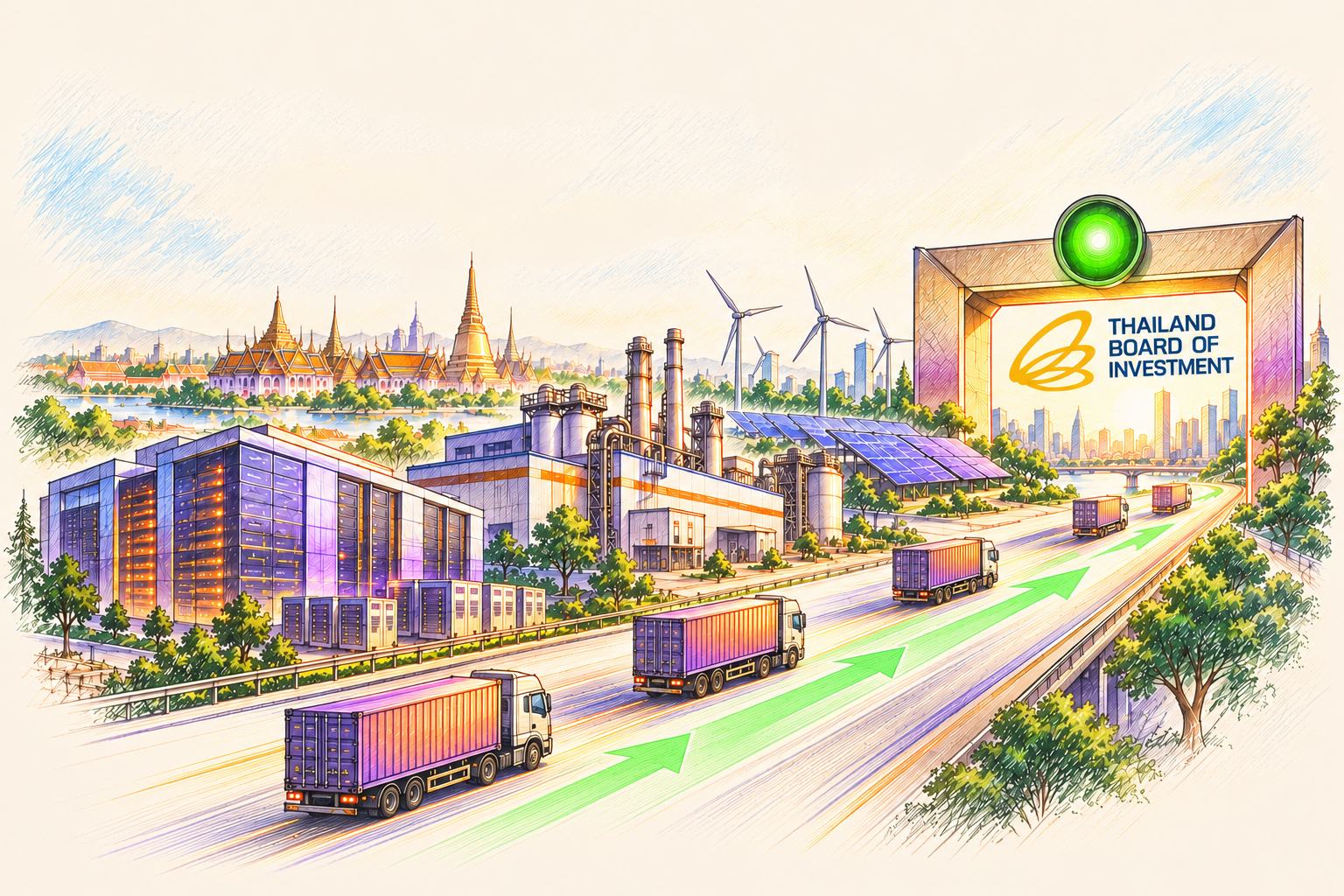
Thailand's government has moved to accelerate roughly 80 large-scale investment projects that have stalled despite already securing approval from the Board of Investment (BOI). Economic ministers approved the "Thailand Fast Pass" plan in late November 2025 to speed up projects worth around 480 billion baht that had been held up by permits, visas, utility connections, and factory construction delays.
Why the delays happened
The projects, approved between 2023 and 2025, span sectors including data centres, clean energy, industrial estates, electronics, EVs, and PCB manufacturing, and have been held back by issues tied to power grid capacity, industrial land availability, and processing backlogs. For foreign investors, these are familiar friction points — the kind that can turn an approved project into a years-long waiting game.
What FastPass changes
The initiative targets a 20 to 50 percent reduction in approval and licensing times, with the Board of Investment coordinating directly with agencies such as the Energy Regulatory Commission, EGAT, PEA, and MEA to clear bottlenecks.
The initiative targets a 20 to 50 percent reduction in approval and licensing times.
Thai officials expect the programme to unlock around 390 billion baht of investment between 2025 and 2027, with further projects to follow. The government is also reviewing outdated regulations more broadly, aiming to make long-term investment easier, not just clear the current backlog.
What this means for businesses
For companies already operating in Thailand or considering entry, FastPass signals a government push to reduce the regulatory drag that has historically slowed project execution — particularly in high-growth sectors like data centres and renewable energy.
For businesses navigating BOI approvals, utility connections, or land acquisition in Thailand, these changes are worth tracking closely as implementation unfolds through 2026 and 2027.