
You and
Atlas Commercial Consulting
Atlas Commercial Consulting is your strategic partner for Thailand and APAC market entry and expansion supporting companies new to Asia and well established.
You're the expert in your industry and we aim to be experts in markets and execution process - We help SMEs, multinationals and economic trade and investment organizations to enter, build, and scale across Asia.
Our ethos is a passion for commerce and being action oriented - Atlas validates and executes informed business decisions.
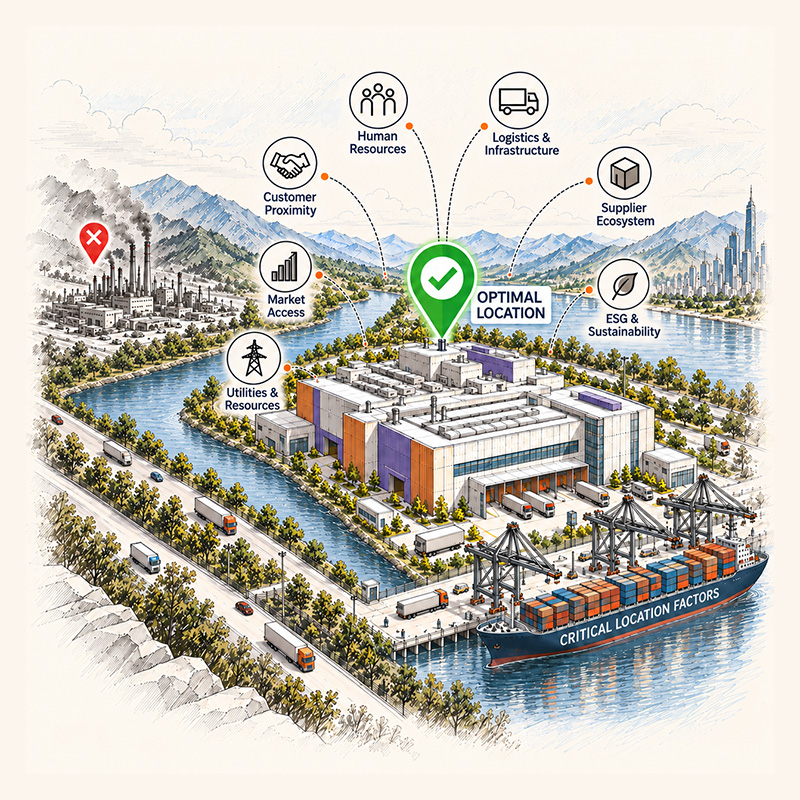
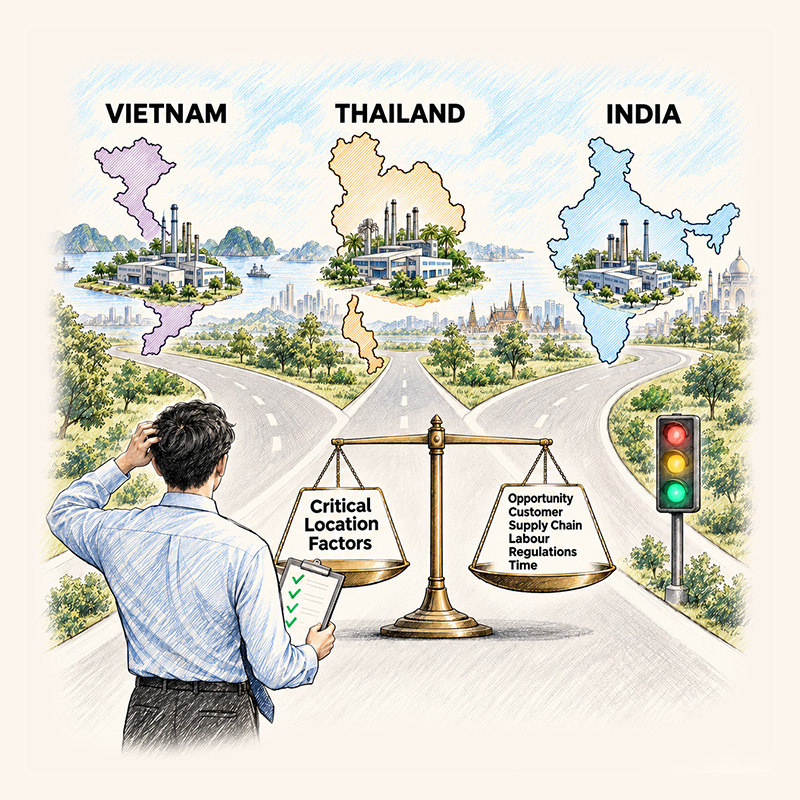
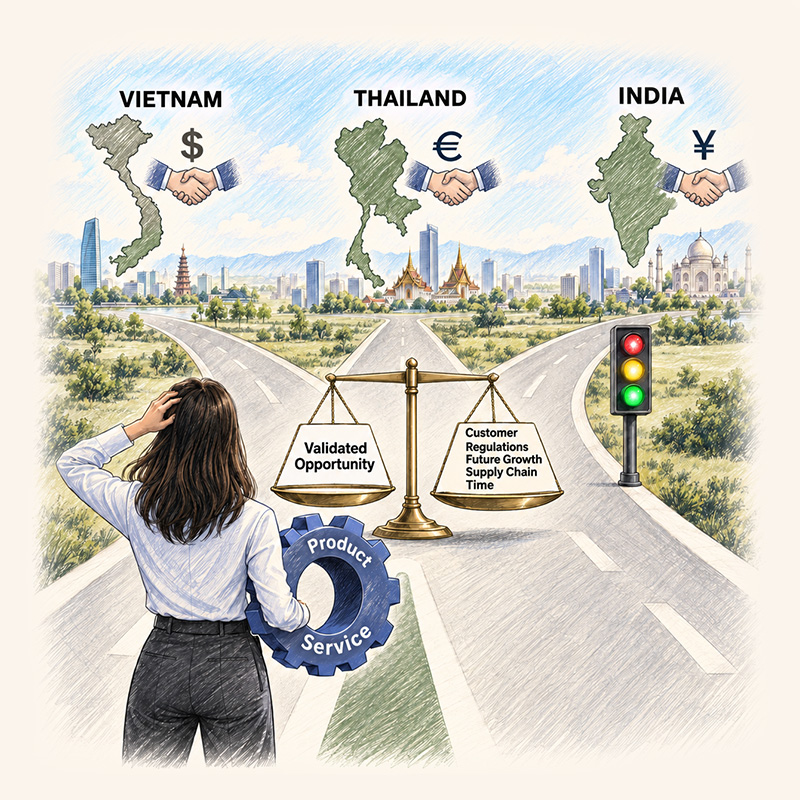





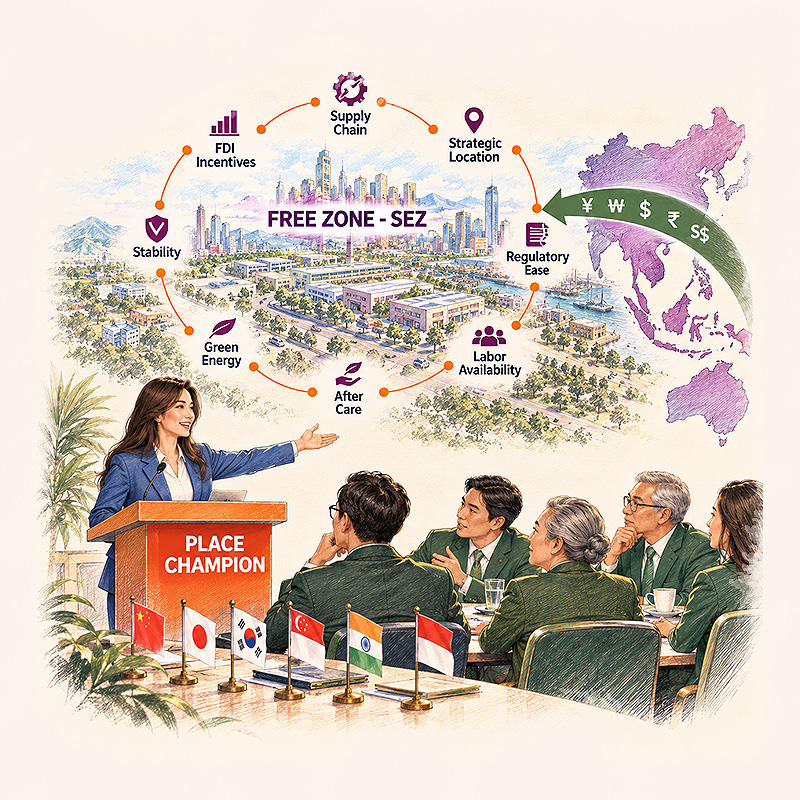

Managing Asia Expansion
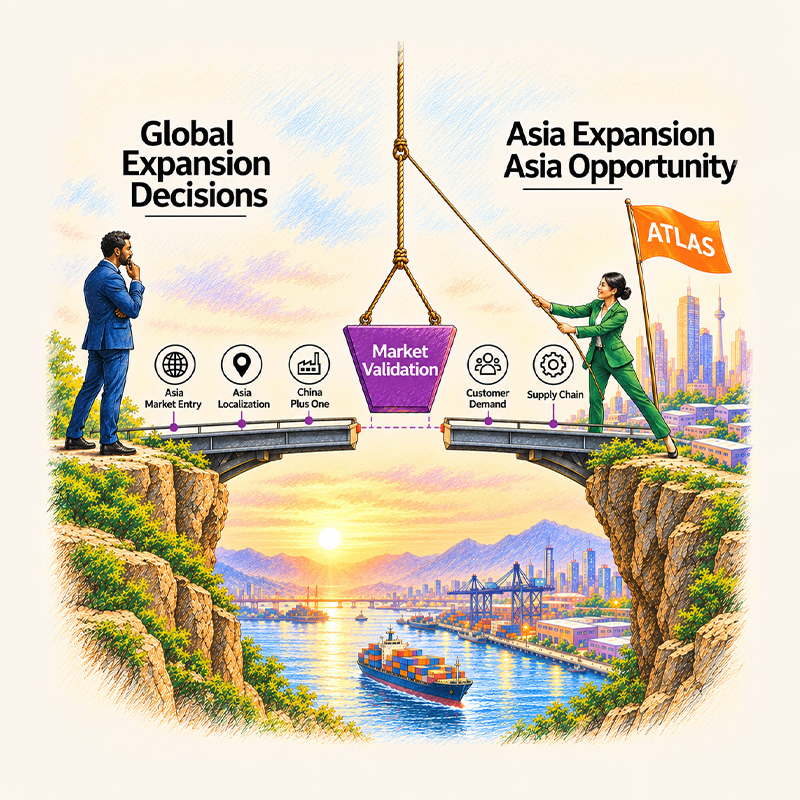
Market Validation

Global Uncertainty & Tariffs
Driven
by you
Every business and their Asia journey is unique.
Whether you are new to the market or long-established, Atlas starts with understanding your company, operations and objective then with the questions that decide whether an expansion succeeds.
YOUR POSITION IN ASIA NOW
Atlas Commercial Consulting understands the challenges of expanding in Asia - We deliver an approach tailored for the nuances of Asian markets and global dynamics applied to the specific needs of clients.
You are new to Asia
Your first Asia decision isn't which country, it's whether to enter a mature market or an emerging one. Each looks attractive for a different reason, and each hides a catch, challenge, or compromise.
Where you are now
- The easy entry point isn't always the scalable one, Singapore is simple to enter but small to scale in, and not an ideal base if a core sales market is somewhere like Thailand.
- The biggest opportunity isn't always the right first move, China offers scale but is the hardest place to start.
- The fastest-growing markets carry the sharpest caveats, India (regulatory complexity), Vietnam (land ownership and IP), Indonesia (fragmentation).
- The most mature markets demand the most patience, Japan is large and high-value but rewards deep localization over quick entry.
- Thailand's modest headline growth hides established verticals and relatively easy market access.
What you need to answer
- Which market fits your goals, the easy entry, the big prize, or the quiet performer?
- Do you start in one market or build a regional footprint from day one?
- A distributor
- A Atlas sales and engineering incubator
- A new manufacturing plant
- New sales, engineering and R&D hubs
- Should BOI or other market entry incentives drive your location choice, or follow it?
- What does the move actually look like, human resources, cost, tariffs, regulation, tax timelines and operational interplay with your current operations?
Find out more about:
Market AssessmentPartner SearchSales Outsourcing/IncubationSite Selection/Location AnalysisContact us
You're an Asia established supplier across tiers
Your OEM customers are moving, and you have to move with them, but coverage gaps and cost pressures make the how anything but simple.
Where you are now
- Your OEM customers are relocating to China Plus One hubs, Thailand, Vietnam, India, and expect you need to follow .
- Your current sales, servicing, and production coverage has gaps in these markets.
- Your distributors are technical specialists but aren't fully penetrating the market.
- Producing in one location and shipping to customers in another is eroding your cost position.
- China is essential but crowded at the high-volume, low-margin end, so you need to look at premium solutions and value-added services
- You must localize to meet your customers' sustainability commitments.
What you need to answer
Where is the real opportunity, and is it where your customers are truly located in density?
- What do those potential customers actually need from your portfolio and in what volumes?
- Where should you set up your Asia sales, engineering, or production hub, and why?
- A new manufacturing plant
- New sales, engineering and R&D hubs
- A Atlas sales and engineering incubator
- Do you build green field or acquire or JV to relocate faster?
- What does the move actually look like, human resources, cost, tariffs, regulation, tax timelines and operational interplay with your current operations?
Find out more about:
Market AssessmentSite Selection & Location AnalysisAcquisition/JV Deal OriginationContact us
You're an Asia established OEM expanding your footprint
A concentrated Asia footprint no longer gives you the resilience or access you need, and tariffs, cost, and domestic competition are forcing the question.
Where you are now
- A China-only or single-location Asia footprint no longer gives you the resilience or market access you need.
- Tariffs are disrupting your exports and supply chains.
- Producing in the West and shipping to Asia is eroding your margins
- The made in the West machine landing at at 20-30% cost premium is no longer justifiable to your customers procurement departments
- China is fiercely competitive, with regulatory favoritism toward domestic players
- Customer are demanding premium solutions and valued-added services
- Your distributors are struggling to meet servicing and engineering demands across new and legacy machines.
- You need to expand while meeting your own sustainability commitments.
What you need to answer
- Where should you diversify beyond a single Asia location, and why there?
- A new manufacturing plant
- New sales, engineering and R&D hubs
- A Atlas sales and engineering incubator
- Do you build green field or acquire or JV to relocate faster?
- How do you compete against, and defend premium ground from, domestic champions?
- If you have a premium cost Western build machine, how do you double down on value added services leveraging an existing customer base and unmet needs?
- How do you pivot towards a “built for Asia machine”
- What does the move actually look like, human resources, cost, tariffs, regulation, tax timelines and operational interplay with your current operations?
Find out more about:
Market AssessmentSite Selection & Location AnalysisAcquisition/JV Deal OriginationContact us
You're an Economic Development trade or investment promotion organization
Your challenge is to balance trade promotion, market access, and investment attraction against real budget constraints, with representation that actually delivers on all three.
Where you are now
- Organizing Asia trade missions from home HQ, or even a regional hub like Singapore, has proven difficult and costly.
- Your delegates don't have the full picture, which verticals hold opportunity in high-growth markets, and which regulatory barriers mean a hard or soft entry.
- A single Asia hub isn't effective for the long-term advocacy and network-building that trade and investment promotion actually require.
- The classic embassy or consulate trade-desk model no longer fits, officers are focused on policy advocacy over execution, with limited resources for it.
- Your trusted long-term representative is nearing retirement, or no longer current with market conditions and opportunity.
- Your delegates need post-entry support, not just introductions.
- Any third-party representative must comply with your procurement, DEI, CSR, and antitrust requirements.
What you need to answer
- Where is the opportunity, by country and industry, and what regulatory barriers stand in the way?
- What type of representation fits your objectives and budget?
- Single mission
- Full-time representation
- Flex models
- Digital-only
- Would a sales incubator help your delegates land and grow in-market?
Find out more about:
Trade MissionsMarket RepresentationFDI Lead GenerationContact us
You're Retail Focused B2C - D2C
You're a retailer or consumer brand
Your brand is established in Asia, often via a hub like Singapore, and the decision now is where to grow next and by what means.
Where you are now
- Directly owned or leased stores launched your brand in Asia, but the cost has you weighing a shift toward e-commerce and D2C.
- Your product is at premium price-point and you need to build consumer advocacy by promotional experiences or new ownership and utility models
- Your authorized distributor or master franchisee is underperforming.
- Grey-market and unauthorized e-commerce imports are building a consumer base you don't control, with no brand consistency, service, or quality assurance.
- Your distribution or master franchise agreements are nearing end of term, with no qualified replacement in place.
- You see an opportunity to localize production or sourcing in Asia, but aren't sure where, or how, to begin.
What you need to answer
- Which consumer segment and market will truly embrace your brand?
- Where is the opportunity, and where should you base your Asia operation, and why?
- Do you go to market through a distribution partner, directly, or via a sales and brand management incubator?
- Should you localize production or sourcing in Asia, and if so, where and how?
- What does the move actually look like, human resources, cost, tariffs, regulation, tax timelines and operational interplay with your current operations?
Find out more about:
Market AssessmentPartner SearchSales Outsourcing/IncubationSite Selection/Location AnalysisContact us
OUR SERVICES
Three practice areas for Asia market entry and expansion
How we help you enter new markets, grow sales and optimize operations footprint
Go-To-Market
Manufacturing
Economic Development
THE PEOPLE BEHIND ATLAS
Our Team of Experts
Over 30 years of combined experience helping private and public sector clients realize opportunities in Asia, supporting go-to-market strategy and execution, manufacturing site selection and inorganic growth.

Andrew A. Davies
Founder and Managing Director Atlas Commercial Consulting.
Andrew Davies, a native of London, United Kingdom, is Managing Director of Atlas Commercial Consulting and a long-time partner of Tractus Asia, helping clients de-risk, form and execute market entry and expansion strategies in Thailand and across Asia.
He combines the process-driven approach of a consultant with the results mindset of a commerce driven operator.
Andrew has supported private and public sector clients in Thailand for 11 years, built on 30 years of multi-sector sales and marketing experience across engineering, marine, retail and hospitality. His core skill is grasping the fundamentals of a business, product or service, isolating the critical success factors, and aligning the objective with the optimal approach. In short, he knows who needs what, where, why and how.
Andrew meets market entry with boots on the ground in promising but challenging locations, mapping commercial ecosystems and industrial capacities against the global uncertainty that both disrupts and creates opportunity across Asia's developed and emerging economies.

John J. Evans
Managing Director Tractus Asia Atlas Strategic Partner: Go-to-market & Asia organic growth
John J. Evans co-founded Tractus Asia Ltd. in 1997 with Dennis Meseroll, whom he met while advising firms on China market entry at a Bangkok site selection firm. Their complementary approach to helping clients launch in Asia became the foundation of what is now a leading Asia-Pacific strategic advisory firm.
To date, John has advised on more than USD 8 billion in trade and investment transactions across many sectors, making him a sought-after expert to multilateral, national and regional economic development organizations across North America, Europe, the Middle East, Africa and Asia. He is also an angel investor in early-stage technology companies targeting Asian growth markets, and is fluent in Thai and conversant in Mandarin and Spanish.

Dennis J. Meseroll
Executive Director Tractus Asia Atlas Strategic Partner: Asia site selection & location analysis
Dennis J. Meseroll co-founded Tractus Asia Ltd. in 1997 with John Evans, whom he met advising firms on China market entry at a Bangkok advisory firm. Their complementary approaches to site selection and market entry became the foundation of what is now a leading Asia-Pacific strategic advisory firm.
He focuses on helping firms develop effective location strategies through a data-based approach, ensuring they understand the indicators for a successful Asia launch.
Dennis has advised on more than USD 8 billion in trade and investment transactions across many sectors, making him a sought-after expert to economic development organizations across North America, Europe, the Middle East, Africa and Asia. He also sits on several company boards in Asia and is an angel investor in early-stage technology, manufacturing and service companies.
A New Jersey native, Dennis has worked in nearly every country in Asia, has lived in Thailand for almost 30 years, and is fluent in Thai.

Martin J. Eleveld
Atlas Strategic Partner: Contract manufacturing, manufacturing process optimization & supply chain planning (localized BOM)
Martin Eleveld is a senior operations and engineering executive with more than 40 years building, running and scaling manufacturing businesses across Southeast Asia. Based in Bangkok, he is CEO and Co-Founder of Asia Integrated Manufacturing Solutions (AIMS), a niche consultancy that helps global brands relocate and stand up production in Thailand, Malaysia and across ASEAN, from product and technology transfers to new product introduction, supplier qualification and quality engineering.
Martin began on the shop floor as a machinist and toolmaker before moving into plant leadership and company ownership. He co-founded M&J Technologies in Thailand, taking it from startup to USD 150 million in annual revenue manufacturing external hard disk drives, and later served as President of Q-Value Add, growing revenue from USD 28 million to 41 million. He has led PCBA and box-build manufacturing, injection molding, die casting, precision machining and electro-mechanical assembly programs for clients including Motorola, Philips, Texas Instruments, Seagate and Western Digital.
Today Martin draws on that four-decade track record to guide AIMS clients through greenfield factory setup, BOI licensing, supplier management and ERP integration, delivering manufacturing solutions with speed, precision and zero surprises.
OUR CLIENTS















Schedule Introduction
Book a free Asia expansion or Asia market entry pathfinder call - your call will focus on:
- Your case understanding
- Goal challenges & feasibility
- Atlas approach
- High level overviews, sector & geography